Open Web-Scale Pretraining Dataset With High Quality Instruction and Reasoning Data Built from Permissive-First Text Sources
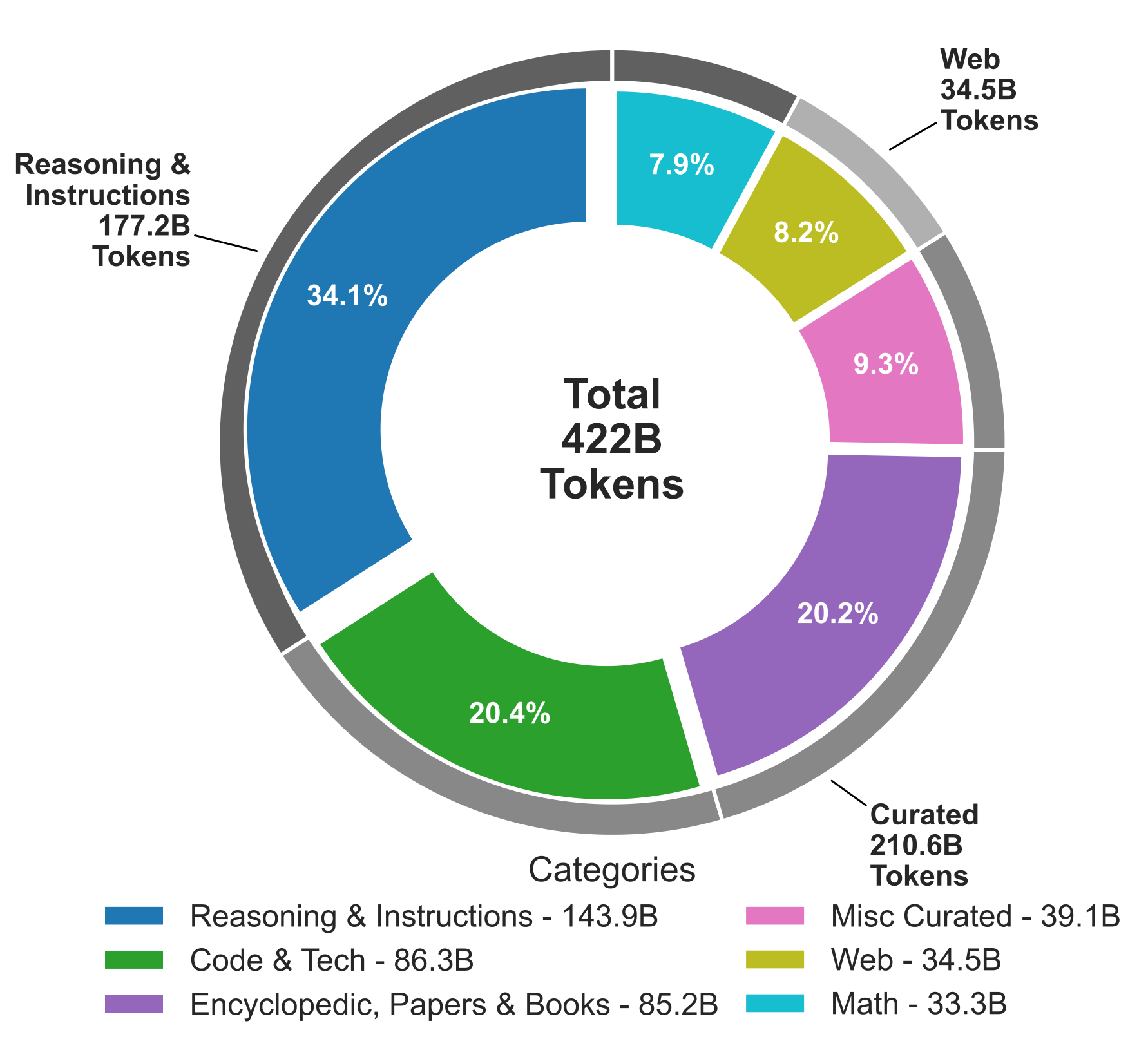
MixtureVitae is a 422-billion-token permissive-first, risk-mitigated pretraining corpus with enhanced reasoning, math, and code capabilities, while being competitive with non-permissive baselines on standard language benchmarks
Numbers below are for a 1.7B base model trained for 300B tokens — no fine-tuning.
Most permissive pretraining corpora try to answer a licensing question. MixtureVitae tries to answer a harder one: how much capability can you recover when the data is provenance-aware from the start. Instead of releasing one more "open" mixture and asking users to trust it, MixtureVitae tags sources by risk tier, keeps synthetic provenance explicit, and lets researchers ablate those choices rather than treating the corpus as a black box.
That is the main difference from The Common Pile / Comma-0.1. Comma-0.1 is a strong permissive baseline, but it is built mostly from traditional permissive sources and reaches its token budget with heavy repetition. MixtureVitae instead combines more unique content with a much denser reasoning and instruction block, so the comparison is not just "cleaner licenses," but a different answer to how permissive data should be composed.
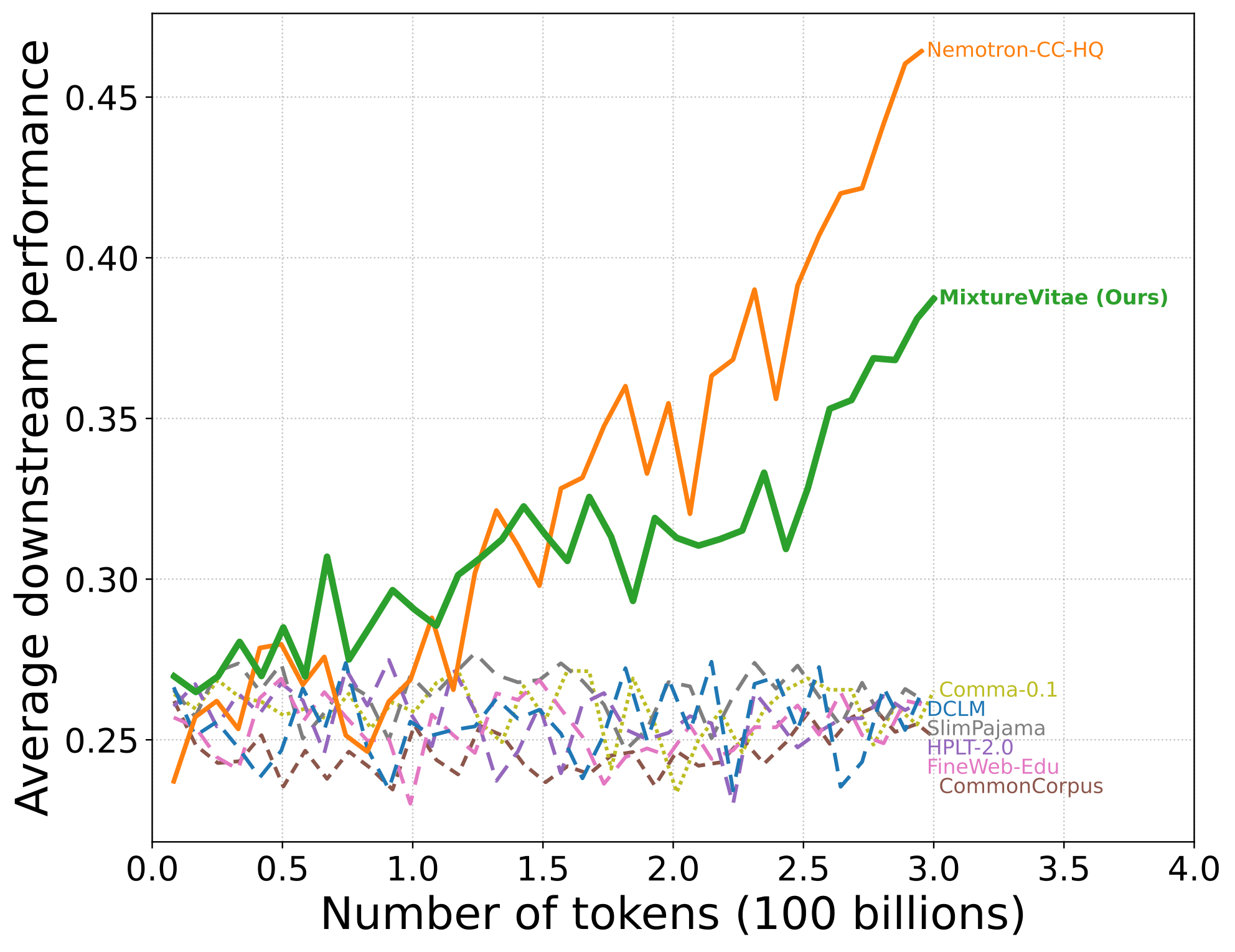
The point is not to make a narrow capability-shaped dataset. The point is to build a permissive general-purpose corpus that keeps strong language-understanding performance while recovering much stronger reasoning, math, and code behavior during pretraining itself. In other words: not breadth or reasoning, but breadth with a reasoning-capable foundation.
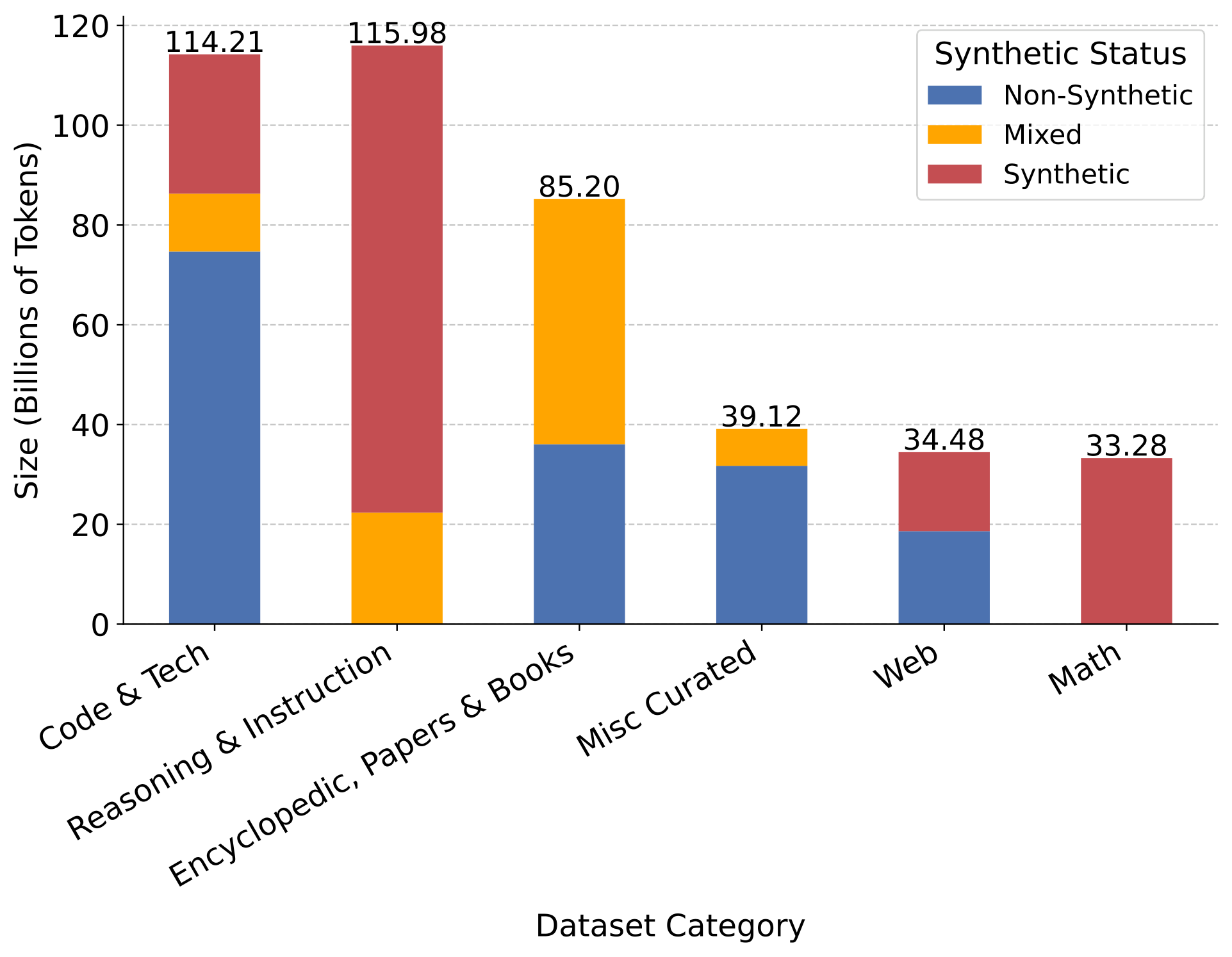
The corpus has three main parts: curated domain sources (scientific papers, code, encyclopedias, patents), a reasoning and instruction block that would usually show up only at fine-tuning, and a smaller web component. Each source is tagged with its synthetic status so the split is transparent.
Every source is assigned to one of three tiers. This is risk-mitigated, not risk-free—copyright law varies by jurisdiction, and users in some regions should get legal advice before using Tier 2 or Tier 3 material.
All models use the same architecture and hyperparameters under the open-sci-ref protocol — only the dataset changes. That makes it straightforward to attribute differences in benchmark scores to the data.
| Training dataset | Tokens | IF-Eval | GSM8K | HumanEval | MBPP | Avg |
|---|---|---|---|---|---|---|
| open-sci-ref — 300B tokens | ||||||
| MixtureVitae permissive | 300B | 0.19 | 0.53 | 0.32 | 0.38 | 0.36 |
| Comma-0.1 permissive | 300B | 0.19 | 0.06 | 0.13 | 0.22 | 0.15 |
| CommonCorpus permissive | 300B | 0.13 | 0.02 | 0.05 | 0.05 | 0.06 |
| C4 mixed | 300B | 0.20 | 0.02 | 0.00 | 0.00 | 0.06 |
| SlimPajama mixed | 300B | 0.14 | 0.02 | 0.05 | 0.00 | 0.05 |
| HPLT-2.0 mixed | 300B | 0.17 | 0.02 | 0.00 | 0.00 | 0.05 |
| DCLM mixed | 300B | 0.13 | 0.02 | 0.01 | 0.01 | 0.04 |
| Nemotron-CC-HQ mixed | 300B | 0.09 | 0.03 | 0.02 | 0.00 | 0.03 |
| open-sci-ref — 1T tokens | ||||||
| FineWeb-Edu mixed | 1T | 0.20 | 0.03 | 0.00 | 0.00 | 0.06 |
| Nemotron-CC-HQ mixed | 1T | 0.13 | 0.03 | 0.01 | 0.04 | 0.05 |
| DCLM mixed | 1T | 0.15 | 0.03 | 0.00 | 0.01 | 0.05 |
| Reference models | ||||||
| SmolLM2-1.7B | 11T | 0.18 | 0.31 | 0.01 | 0.35 | 0.21 |
| SmolLM2-1.7B-Instruct | 11T | 0.28 | 0.37 | 0.28 | 0.37 | 0.33 |
Heavy instruction content in a pretraining corpus raises an obvious question: are these scores real, or is the model just memorizing test items? The paper addresses this directly.
A 13-gram decontamination sweep removed overlapping test items across all benchmarks. Scores were stable — GSM8K went from 0.53 to 0.54, MBPP stayed at 0.38. Retraining after removing the contaminated shards produced nearly identical results.
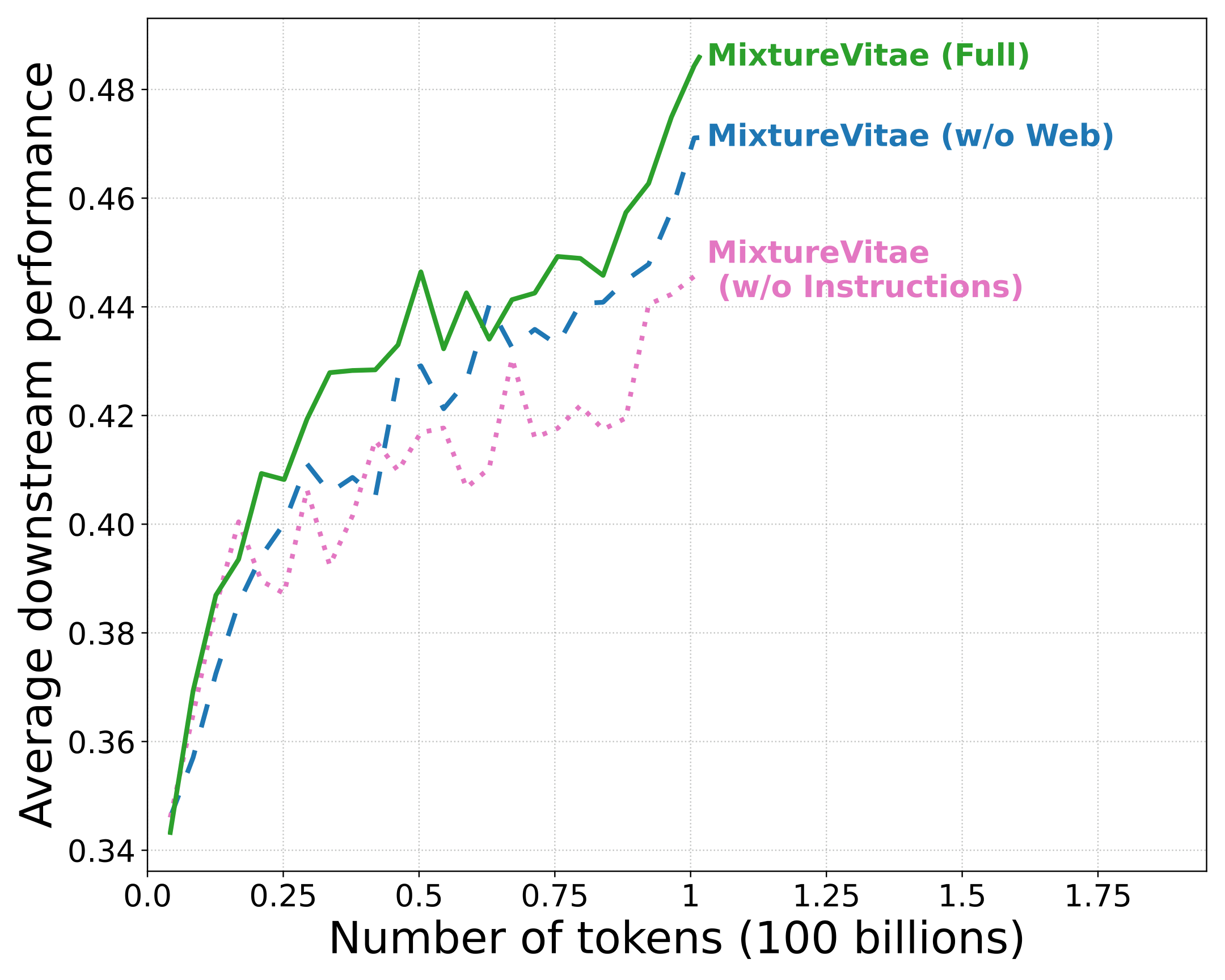
Three models were trained: the full mix, without web data, and without instruction/reasoning data. Removing instructions caused GSM8K to drop from 0.47 to 0.03. Removing web data dropped it to 0.41. The instruction block is doing most of the work.
Tier 2(b) — synthetic data from restricted or opaque generators — makes up about 4% of the corpus. Removing it produces a training curve indistinguishable from the full model. Users who need stricter provenance can exclude it without giving up performance.
Three variants were trained at 100B tokens: the full mix, without web data, and without the instruction and reasoning block.
MixtureVitae starts with sources that are clearly reusable. Licensing comes first; quality is a secondary filter within that set.
Most web-scale datasets go the other direction — start from a broad crawl, filter out low-quality content, and treat licensing as someone else's problem. MixtureVitae inverts that: a source only gets in if its license is clear (CC-BY, Apache 2.0, public domain) or falls into a narrowly justified lower-risk category like US government works.
No. The goal is lower risk, not a universal legal guarantee. That is why the data is split into tiers and why users can exclude the stricter slices.
The tiering rests primarily on US fair-use doctrine and the EU Text and Data Mining exception. Copyright law varies by country — if you are deploying Tier 2 or Tier 3 material commercially outside the US or EU, it is worth talking to a lawyer. Users who want the most defensible subset can restrict to Tier 1 only.
Both are permissive baselines. The main difference is synthetic data. The Common Pile (which Comma-0.1 trains on) deliberately avoids synthetic content. MixtureVitae includes a large block of reasoning and instruction data generated from permissive seeds — and that turns out to matter a lot for math and code.
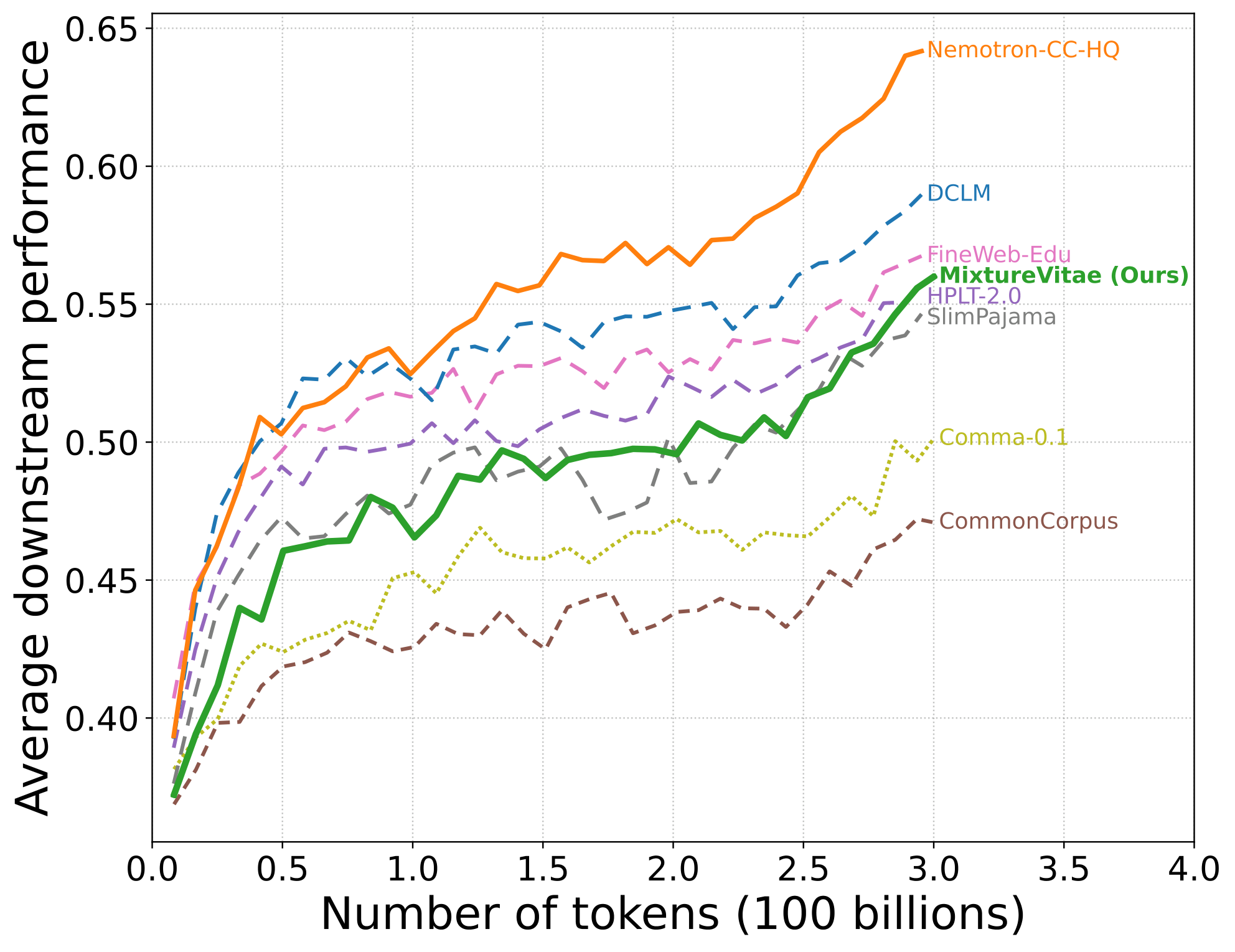
On general benchmarks at 1.7B / 300B tokens: MixtureVitae 0.56, Comma-0.1 0.50, CommonCorpus 0.47. On GSM8K specifically: 0.53 vs. 0.06 vs. 0.02. Comma-0.1 also repeats most of its sources up to 6× to reach 1T tokens — MixtureVitae contains 422B unique tokens without repetition.
If you use MixtureVitae in your work, please cite:
@article{nguyen2026mixturevitae,
title = {{MixtureVitae}: Open Web-Scale Pretraining Dataset With
High Quality Instruction and Reasoning Data Built from
Permissive-First Text Sources},
author = {Huu Nguyen and Victor May and Harsh Raj and Marianna Nezhurina and
Yishan Wang and Yanqi Luo and Vu Minh Chien and Taishi Nakamura and
Ken Tsui and Van Khue Nguyen and David Salinas and
Aleksandra Krasnod{\k{e}}bska and Christoph Schuhmann and Mats Leon Richter and
Xuan-Son Vu and Jenia Jitsev},
journal = {Transactions on Machine Learning Research},
issn = {2835-8856},
year = {2026},
url = {https://openreview.net/forum?id=SyCcUNUUMf},
note = {Featured Certification}
}